Maritime Ap Vendor Evaluation Seven Questions — hero image

This article is part of our series on how to close the control gap in maritime's procure to pay workflow (article seven of seven)

What should I look for in maritime AP automation software?

Maritime-built AP software handles the exception types specific to shipping operations: partial deliveries, vessel confirmation of receipt, port agent invoices without PO anchors, multi-entity group structures, and continuous compliance screening embedded in the payment workflow. Generic AP tools adapted for maritime handle standard matching well but struggle at the operational edges, which in maritime is where most of the exposure sits.

Most AP platforms look capable in a product demonstration. Invoice ingestion, document matching, approval workflow, payment integration: the standard process looks clean when the invoices are straightforward. The interesting conversation is about what happens when they are not.

SpecTec's 2026 research across operators managing 3,150 vessels found three-way matching failing 60 to 70 percent of the time in maritime, at a cost of $85 per failed match. Those exception rates do not come from poor software configurations. They come from software that was not built around the transaction patterns that produce them.

A solution built for maritime handles these exceptions as standard cases. A generic tool handles them through workarounds, or not at all. That difference is not visible in a standard demonstration. It becomes visible when you ask the right questions.

Open magazines with a ship image and a book titled "Navigating New Financial Realities" on a surface.

Build an effective business case for AP automation

Assess your current processes, get tips on vendor search and sharpen your objectives with our latest guide on maritime AP automation

The seven questions to ask evert maritime AP vendor

  1. Does the solution support four-way matching with vessel confirmation of receipt? A good answer describes how vessel confirmation is captured and connected to the invoice clearing process, and what happens when the vessel's confirmation disagrees with the delivery note.


  2. How does the system handle invoices with no PO anchor, such as port agent disbursement accounts? A good answer describes matching logic that works without a PO reference. A weak one routes all non-PO invoices to manual review.


  3. How does duplicate detection work across a multi-entity group? Group-level detection across all legal entities is the right answer. Within-entity only is the wrong architecture for ship management structures.


  4. How does the system handle partial deliveries generating multiple invoices against the same PO? Cumulative tracking against the original PO value is the right answer. Per-invoice tolerance checking is not.


  5. What does compliance screening look like inside the payment workflow? Continuous screening embedded in payment execution is the right answer. Onboarding-level screening with manual updates is not.


  6. How are exceptions routed and resolved? Good exception routing delivers the exception with full context attached, PO, vessel history, prior invoices, supplier relationship. Bad exception routing delivers the exception to a queue and leaves the AP team to reconstruct the context.


  7. What maritime operational context is the matching logic built on? A good answer is specific: document types, port call patterns, DA invoice handling, vessel categories. A generic answer describes configurable matching rules that could apply to any industry.

What good looks like and why it's worth the homework

The Hackett Group found that organisations using advanced AP platforms achieve 60 percent touchless processing, cycle times 59 percent faster, and productivity 3.5 times higher than those running manual processes. That performance gap reflects whether exception logic was designed from maritime patterns or configured onto a generic platform afterward.

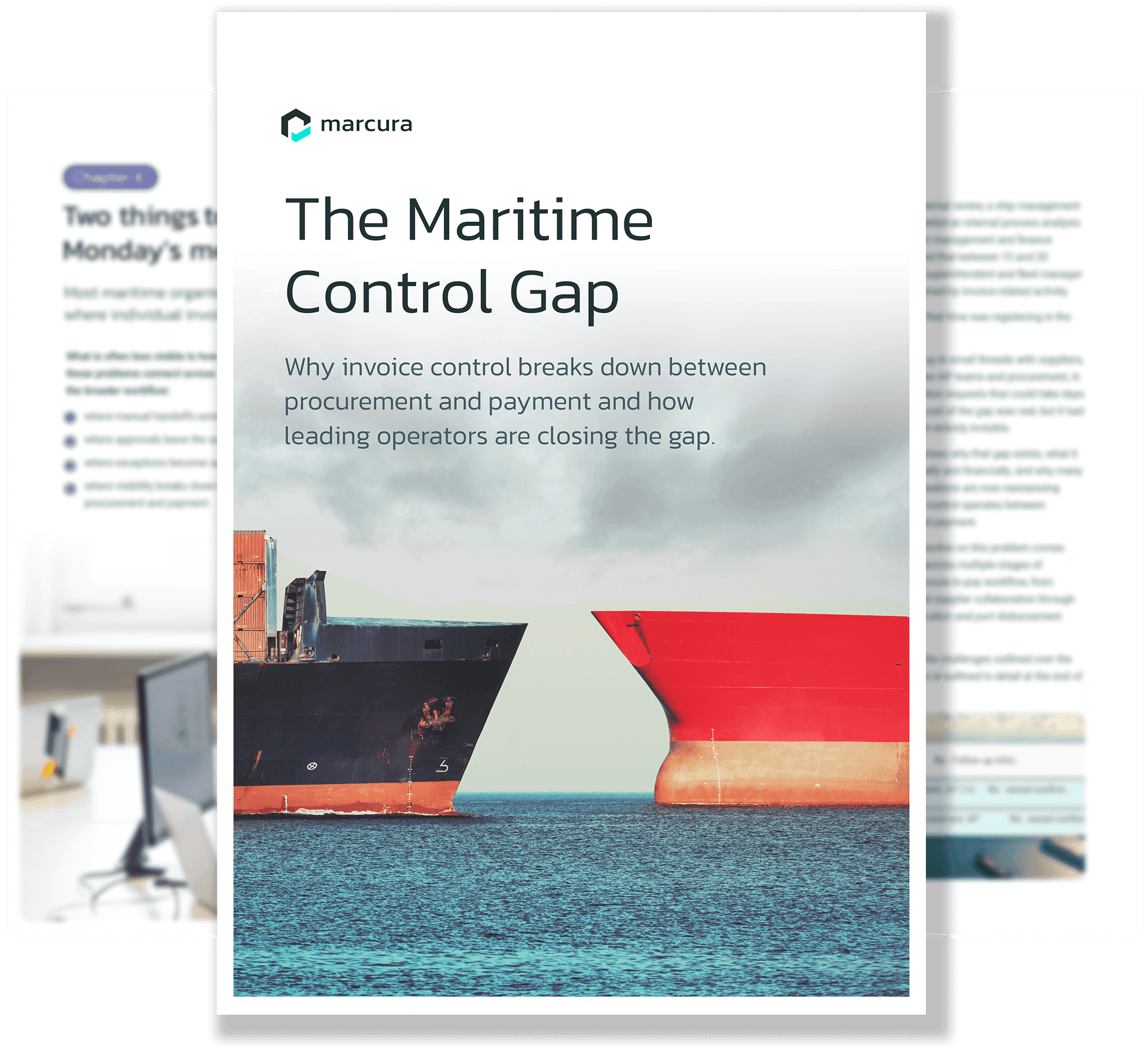
The Maritime Control Gap covers vendor evaluation in detail, with a full question set and what strong answers look like in practice.

What integrations does maritime AP automation software need to connect with our PMS and ERP?

At minimum: read PO data from your procurement or ERP system to support matching, write invoice and approval records back to your ERP to keep it as the system of record, connect to your banking infrastructure for payment release, and accept vessel confirmation inputs from whatever system your crew uses. The practical question is whether data exchange with your existing systems is bidirectional and automated, or still requires manual export and import steps.

How do I run an AP automation pilot in ship management without disrupting live payment runs?

Run the automation layer in parallel with the existing process for a defined period. Both workflows run, automation output reviewed against existing approvals before replacing them. Set a clear exit criterion: a target first-pass match rate and exception rate over a set number of invoices. The risk of a parallel run is it doubles AP workload temporarily. Define the endpoint before starting.

How do I build the internal business case for maritime AP automation?

Three layers. The cost layer: what the current process costs across manual handling, system fragmentation, accepted variances, and compliance exposure, benchmarked against the Hackett Group's 60 percent touchless and 24 percent lower staffing figures for advanced AP platforms. The control layer: what fraud risks and audit trail gaps automation closes. The scale layer: what fleet growth looks like under a manual process versus a connected one, since manual AP costs scale linearly while a connected process does not.

What does a structured vendor evaluation process for maritime AP automation look like?

Maritime AP vendor evaluation works in two stages. Use the seven questions here to filter before you see any demonstrations. The answers reveal whether exception handling was designed for maritime or configured onto a generic platform afterward. Then bring your own exception scenarios to the demonstration: a partial delivery against a vessel confirmation, a port agent DA invoice, a multi-entity duplicate. A vendor built for maritime handles these without preparation. One that is not will route them to manual review.

What integrations does maritime AP automation software need to connect with our PMS and ERP?

At minimum: read PO data from your procurement or ERP system to support matching, write invoice and approval records back to your ERP to keep it as the system of record, connect to your banking infrastructure for payment release, and accept vessel confirmation inputs from whatever system your crew uses. The practical question is whether data exchange with your existing systems is bidirectional and automated, or still requires manual export and import steps.

How do I run an AP automation pilot in ship management without disrupting live payment runs?

Run the automation layer in parallel with the existing process for a defined period. Both workflows run, automation output reviewed against existing approvals before replacing them. Set a clear exit criterion: a target first-pass match rate and exception rate over a set number of invoices. The risk of a parallel run is it doubles AP workload temporarily. Define the endpoint before starting.

How do I build the internal business case for maritime AP automation?

Three layers. The cost layer: what the current process costs across manual handling, system fragmentation, accepted variances, and compliance exposure, benchmarked against the Hackett Group's 60 percent touchless and 24 percent lower staffing figures for advanced AP platforms. The control layer: what fraud risks and audit trail gaps automation closes. The scale layer: what fleet growth looks like under a manual process versus a connected one, since manual AP costs scale linearly while a connected process does not.

What does a structured vendor evaluation process for maritime AP automation look like?

Maritime AP vendor evaluation works in two stages. Use the seven questions here to filter before you see any demonstrations. The answers reveal whether exception handling was designed for maritime or configured onto a generic platform afterward. Then bring your own exception scenarios to the demonstration: a partial delivery against a vessel confirmation, a port agent DA invoice, a multi-entity duplicate. A vendor built for maritime handles these without preparation. One that is not will route them to manual review.

What integrations does maritime AP automation software need to connect with our PMS and ERP?

At minimum: read PO data from your procurement or ERP system to support matching, write invoice and approval records back to your ERP to keep it as the system of record, connect to your banking infrastructure for payment release, and accept vessel confirmation inputs from whatever system your crew uses. The practical question is whether data exchange with your existing systems is bidirectional and automated, or still requires manual export and import steps.

How do I run an AP automation pilot in ship management without disrupting live payment runs?

Run the automation layer in parallel with the existing process for a defined period. Both workflows run, automation output reviewed against existing approvals before replacing them. Set a clear exit criterion: a target first-pass match rate and exception rate over a set number of invoices. The risk of a parallel run is it doubles AP workload temporarily. Define the endpoint before starting.

How do I build the internal business case for maritime AP automation?

Three layers. The cost layer: what the current process costs across manual handling, system fragmentation, accepted variances, and compliance exposure, benchmarked against the Hackett Group's 60 percent touchless and 24 percent lower staffing figures for advanced AP platforms. The control layer: what fraud risks and audit trail gaps automation closes. The scale layer: what fleet growth looks like under a manual process versus a connected one, since manual AP costs scale linearly while a connected process does not.

What does a structured vendor evaluation process for maritime AP automation look like?

Maritime AP vendor evaluation works in two stages. Use the seven questions here to filter before you see any demonstrations. The answers reveal whether exception handling was designed for maritime or configured onto a generic platform afterward. Then bring your own exception scenarios to the demonstration: a partial delivery against a vessel confirmation, a port agent DA invoice, a multi-entity duplicate. A vendor built for maritime handles these without preparation. One that is not will route them to manual review.

Generic AP tools adapted for maritime handle standard matching well but struggle at the operational edges, which in maritime is where most of the exposure sits.

Open magazines with a ship image and a book titled "Navigating New Financial Realities" on a surface.

Improve procure-to-pay control and replace fragmented account payable matching steps with one fully governed end to end workflow.

Struggling with invoice management? We can help

Digital documents displaying data visuals and insights, with the title "Beyond the Model" prominently featured.

New guide

Take control of Procure-to-Pay

Why invoice control breaks down between PO and payment — and how leading ship managers close the gap. Free guide, plus two diagnostic tools.

brown concrete building near body of water during daytime

Products

Solutions

Marcura AI

Resources

Careers

Book a demo

Products

Solutions

Marcura AI

Resources

Careers

Book a demo
Event preview
Live webinar
One System for Every Drydocking, Repair, and Inspection
One cloud platform for drydockings, repairs, refits and inspections — with supplier sourcing and approvals built in.
Live webinar
One System for Every Drydocking, Repair, and Inspection
One cloud platform for drydockings, repairs, refits and inspections — with supplier sourcing and approvals built in.