




Plan your voyages with
world-class maritime data
2.5 Million Port calls
50 Million Statement of facts events
4.5 Million DAs
37.5 Million invoices
600k + Statement of Facts
57k+ Charterparties
2 Million Legal entities

PortLog
Pre-plan voyages and get fixture estimations right
Estimate and plan your port calls based on our data river, understand time and cost and mitigate the risks of mis-pricing freight.
DA-Desk
Port cost management optimised & simplified
We handle your port call planning to reduce expenses and ensure full transparency in your disbursement accounts.
Marcura Claims
The complete laytime claims solution
Streamline, manage, and resolve your claims, reduce expensive mistakes and help eliminate disputes.
Get voyage planning and fixture estimations right
Predict your port calls better by accessing market-leading data and avoid unexpected costs.


What is PortLog and what problem does it solve?
When you ask what PortLog is and what problem it solves, you’re really asking how it helps you handle the “black box” of time and risk in port.
PortLog is a pre-fixture data and risk management platform for ship operators that focuses specifically on the port part of the voyage: turnaround time, port costs, and port/terminal restrictions.
By using structured port data and millions of digitised Statements of Facts, PortLog helps you estimate time in port and related costs more accurately, so you can reduce unpaid time, avoid unpleasant surprises on the P&L, and sharpen your freight pricing.
Who is PortLog for and what types of voyages does it support?
If you are wondering who PortLog is for and what types of voyages it supports, the answer is that PortLog is built primarily for ship operators in commercial tramp shipping who make frequent port calls.
It is especially relevant for dry and tanker operators with at least dozens of commercial port calls per year, where time in port and port risk can significantly impact voyage profitability.
The main users are Heads of Chartering, Freight, or Shipping, and their chartering and digital teams who need accurate, fast pre-fixture estimates for ports and terminals.
What problems does PortLog help me solve as a chartering or freight manager?
When you ask what problems PortLog helps you solve as a chartering or freight manager, you’re asking how it improves your everyday pre-fixture decision-making.
PortLog helps you reduce the risk of mis-pricing freight by improving estimates of port time, port costs, and unpaid time.
It replaces a fragmented process—searching old emails, consulting colleagues, and chasing agents—with a single platform of structured port and terminal data.
It also reduces your reliance on individual “port gurus” by turning tacit experience into shared, data-driven insight that can be used by the whole team, including less experienced charterers.
How does PortLog help me avoid mis-pricing freight and unpaid time in port?
If you want to know how PortLog helps you avoid mis-pricing freight and unpaid time in port, the key is how it uses data to replace guesswork.
PortLog uses a very large, structured dataset built from digitised Statements of Facts and agent data to estimate time in port and port costs more accurately.
It highlights how often traditional buffers are either too small (creating exposure to unpaid time) or too large (over-protecting and hurting competitiveness).
With PortLog Pro, you can model laytime, demurrage, and despatch at terminal level and understand the financial impact of different assumptions, helping you set sharper, more defensible freight rates.
How does PortLog improve my pre-fixture voyage estimation process compared with my current tools?
When you ask how PortLog improves your pre-fixture voyage estimation process compared with your current tools, you are asking how it changes the way you work day-to-day.
PortLog centralises port-related information in one platform instead of forcing you to piece together estimates from emails, spreadsheets, and agent calls.
PortLog Core gives you structured data on time in port, terminal performance, restrictions, and conditions, while PortLog Pro adds automated laytime and cost modelling.
This combination allows you to create, compare, and refine port assumptions much faster and with fewer manual calculations, freeing you to focus on commercial judgement rather than data hunting.
How does PortLog reduce my reliance on individual experience and tacit knowledge?
If you are concerned about relying too heavily on a few experienced colleagues, then asking how PortLog reduces reliance on individual experience and tacit knowledge is about resilience and scalability.
PortLog captures and exposes port behaviour through structured data based on millions of observed port events.
This means that instead of depending solely on “who remembers what” for a given terminal, your team can access consistent, historical patterns directly in the platform.
Over time, as more learnings are added, PortLog becomes a shared memory bank that helps new joiners become productive faster and reduces the risk that expertise walks out the door when people move on.
What is the difference between PortLog Core and PortLog Pro?
When you ask about the difference between PortLog Core and PortLog Pro, you are trying to understand which level of capability best fits your needs.
PortLog Core focuses on providing structured time-in-port data, terminal performance, restrictions, and tools such as rain estimators, holiday calendars, and Agent Request.
PortLog Pro includes everything in Core and adds predictive and financial layers: estimating laytime from digitised SoFs and CP terms, modelling port costs, predicting demurrage vs despatch, and comparing PortLog outputs with your Veson IMOS voyage estimates.
In short, Core gives you the foundational port insight, while Pro turns that insight into forward-looking commercial calculations.
What kind of data does PortLog use, and how is it different from AIS or agents’ emails?
If you are asking what kind of data PortLog uses and how it differs from AIS or agents’ emails, you are comparing traditional information sources with a structured data platform.
PortLog combines digitised Statements of Facts, agent data, DA-related information, AIS, and weather into an anonymised, cleansed dataset focused at the terminal level.
Unlike one-off agent emails or scattered internal notes, PortLog’s data is standardised so you can compare ports and terminals consistently and apply those comparisons to new fixtures.
AIS and ad-hoc emails still have value, but PortLog turns them into usable, repeatable insights at scale.
How accurate and unique is PortLog’s port data?
When you ask how accurate and unique PortLog’s port data is, you are really probing whether you can trust it for important commercial decisions.
PortLog’s data is built on a very large number of port events, derived from digitised SoFs and related operational records, and is then cleansed, standardised, and anonymised.
This gives you a consistent view of how ports and terminals actually behave over time.
Because the data set is built at scale and is not simply a re-packaging of your own emails or a small sample of cases, PortLog can provide insights that are difficult to reproduce in-house and hard to find elsewhere.
How does PortLog integrate with the Veson IMOS Platform?
If you are asking how PortLog integrates with the Veson IMOS Platform, you want to know how your existing voyage estimation workflow changes.
As a Veson platform partner, PortLog can send its time-in-port and cost estimates directly into Veson IMOS so you can use them in your voyage calculations.
You can compare PortLog’s predictions with your IMOS estimates, see the dollar impact of differences, and use single sign-on and embedded workflows to minimise extra clicks.
In practice, this means PortLog becomes a decision layer on top of IMOS rather than a separate, disconnected tool.
Are you a Port Agent? Create a PortPages profile on the platform that places Agents closer to principals and prospects.
Contract Intelligence
Get the charterparty right before the voyage begins
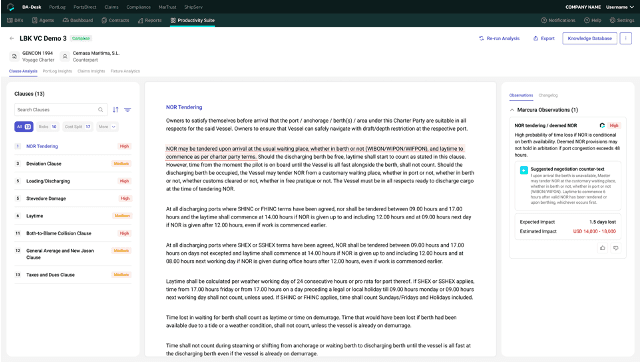
Contract Intelligence scores every CP for risk and surfaces what needs attention before the fixture is concluded, turning manual review into a structured, repeatable risk gate, with full traceability from agreed to executed.
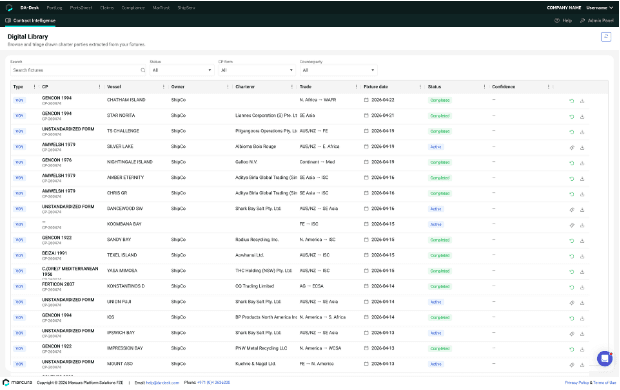
Optimise your port cost management
Let us handle your port call planning to reduce expenses and ensure full transparency in your disbursement accounts.
Get the guide

Do you provide customer support (e.g. manage queries on a day-to-day basis)?
Yes. Our Customer Success team members are highly experienced and knowledgeable professionals who have proven problem-solving skills. They provide 24/7 support through phone calls, live chats (with actual people, not bots) and emails.
Does your company obtain confirmation from the customer prior to making, agreeing or releasing any payments?
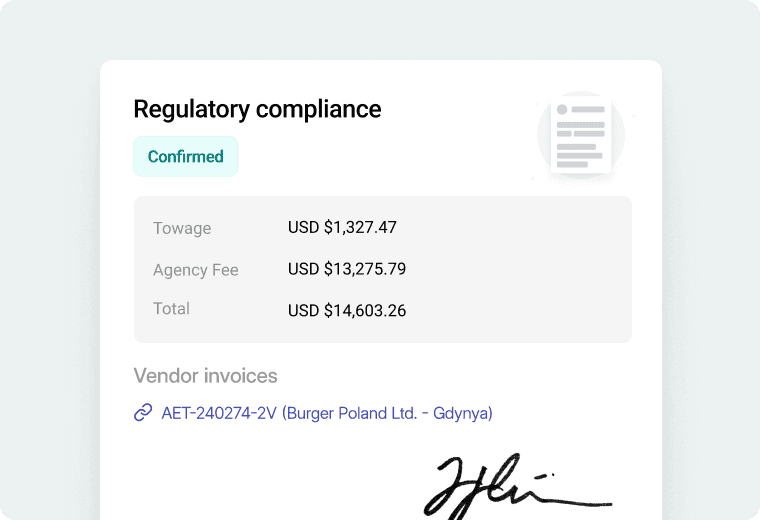
During the onboarding process, each customer advises on their current DA and payment approval process which can be replicated in the DA-Desk System. Only once all approvals have been received, as per the customer’s approval matrix, will the PortPayables team initiate a payment. For audit purposes, there is an audit trail indicating when and who approved a particular payment transaction.
What is DA-Desk and who is it for?
DA-Desk is a digital disbursement account (DA) and port cost management platform designed for ship owners, operators, managers and charterers who process port calls and DAs in shipping.
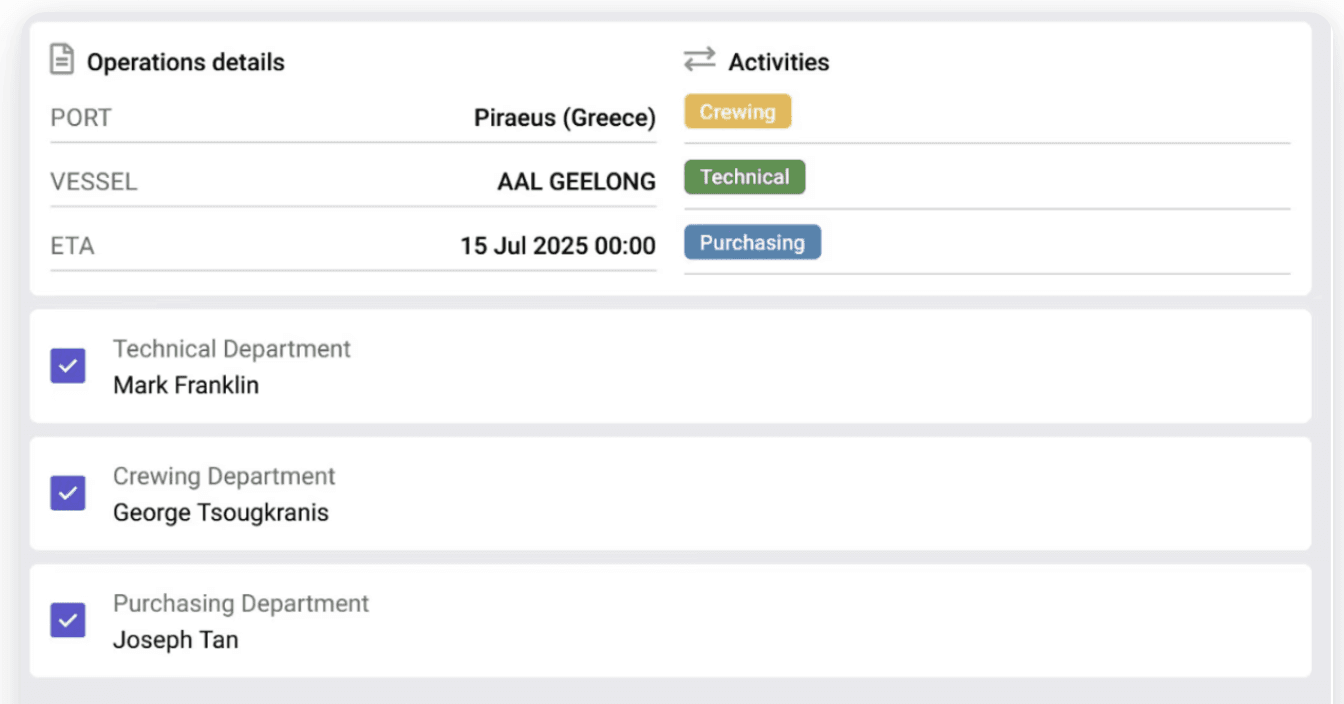
It automates port cost management “from agent appointment to voyage closing,” including DA checking, screening, validation, port expenditures and payments, while integrating with your existing Voyage Management System (VMS).
DA-Desk is used by 350+ customers, covering more than 200,000 port calls per year, with a global team of 373 people handling around $13bn in payments per year.
How does DA-Desk work from agent appointment to voyage closing?
DA-Desk works from agent appointment to voyage closing through a simple, three-touchpoint process that guides you from selecting an agent to approving the final DA:
Appoint the port agent (either your preferred agent or one from DA-Desk’s directory of 10,000+ agents),
Approve the Proforma DA (PDA), and
Approve the Final DA (FDA).
Behind those three touchpoints, DA-Desk’s team and systems handle DA checking, validation, screening, port expenditures and payment processing, together with compliance workflows and reporting.
Before a PDA is released to you, DA-Desk’s systems also run over 1,500 automated validation and verification checks on the port call data, the nominated port agent and the supporting documentation.
These checks help confirm that the appointed agent is legitimate and appropriate and that the PDA has been submitted in an official, accurate and complete form.
What are the main benefits of using DA-Desk for port cost management?
The main benefits of using DA-Desk for port cost management are risk reduction, smart operations, reduced cost and deep VMS integration.
DA-Desk automates key DA tasks such as checking and validating PDAs and FDAs, managing payments and applying compliance checks, so your teams can work faster and smarter with fewer manual steps.
DA-Desk helps mitigate financial, legal, transactional, regulatory and operational risks, while giving you transparency on your port costs and payments.
From a financial perspective, customers typically see measurable cost savings per port call compared with managing DAs and payments entirely in-house.
According to a DA-Desk brochure, a “typical vessel” using DA-Desk saves an average of US$700 per port call. For a fleet making around 800 port calls per year, that corresponds to approximately US$560,000 in annual savings, on top of the productivity and risk-reduction benefits.
Are you able to challenge and validate tariff and non-tariff port call costs for EDAs and FDAs?
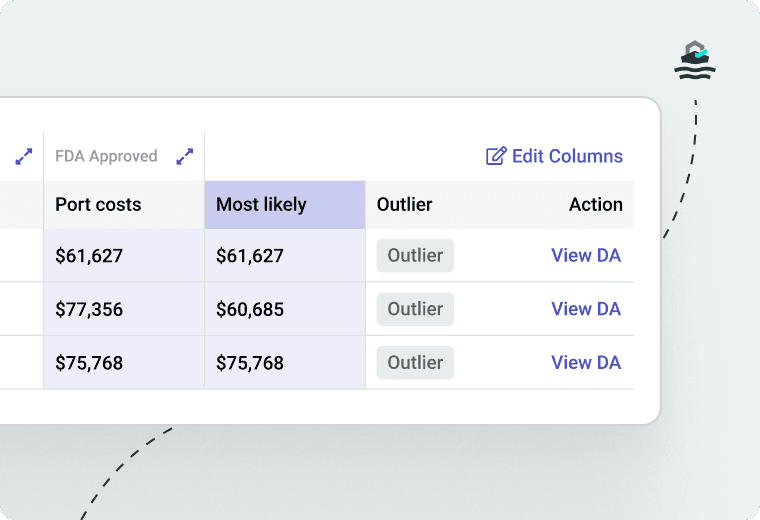
DA-Desk can challenge and validate both tariff and non-tariff port call costs for Estimated Disbursement Accounts (EDAs) and Final Disbursement Accounts (FDAs).
DA-Desk will not process any payment that is unsupported by an invoice and closely scrutinises every invoice presented, exercising every commercially reasonable effort to verify that the invoice is legitimate.
If an invoice or document contains phrases such as “facilitation payment” or “facilitating payment”, DA-Desk will not process that invoice.
DA-Desk also uses a proprietary sanctions-compliance system powered by Dow Jones Sanction Alert to screen vendors, agents and transactions.
Do you validate DAs to ensure costs are correct as per tariffs or agreements and that no facilitation payments are accepted?
DA-Desk validates DAs to ensure that costs are correct as per published tariffs or customer agreements and that no facilitation payments are accepted.
DA-Desk scrutinises every invoice and will not validate a DA if the transaction is not supported by an invoice, if a third-party service is billed under the port agent’s letterhead, or if an expense is not in the tariff.
Without exception, DA-Desk will not process any invoice that contains terms such as “facilitation payment”, “facilitating payment” or “payment for facilitating [a particular transaction]”.
Can you track discounts for environmentally recognised vessels and frequency-based rebates?
DA-Desk can track discounts for environmentally recognised vessels and frequency-based rebates as part of its discount management capabilities.
DA-Desk has developed a tool to record and track most available discounts, including schemes based on ESI, green awards, ice class, bow thrusters, ISO and other energy-efficiency criteria, hull structure and flag-based discounts.
The system also tracks compulsory and optional charges (such as watchmen, garbage removal, overtime or shipping associations), as well as rotation/frequency-based, activity-based, port-stay and tariff-based rebates.
Are historical DA costs checked as part of your validation process?
Historical DA costs are checked as part of DA-Desk’s validation process to ensure that current cost estimates are reasonable and aligned with past experience.
Every DA goes through multiple historical algorithm calculations to ensure that the estimated costs are aligned with historical calls.
DA-Desk uses its extensive database of historical information – such as number of tugs used, hours alongside and the likelihood of overtime – to assess the reasonableness of costs on each DA that is processed.
Do you benchmark the cost items within the PDA?
DA-Desk benchmarks the cost items within the PDA to provide structure, transparency and comparative insight into port costs.
Many shipping companies do not systematically benchmark their port cost items today, which is one of the reasons they work with DA-Desk in the first place—DA-Desk provides that structure and transparency for them.
According to internal FAQ material, every cost quoted on the PDA is validated and benchmarked, and multiple factors are considered when assessing whether the cost items are appropriate and whether relevant discounts can be applied - for example historical port calls, published tariffs, local practices, discount schemes and customer-specific agreements.
Get access to contracted port services embedded into DA-Desk
Comprehensive overview of port expenditures
Including information on statements of account per port Agent, savings generated for management accounting reports and cash flow forecasts for day-to-day practical needs.
Manage your laytime and demurrage claims
Our 100+ experts are ready to streamline, manage or resolve your claims, enhancing efficiency in your daily voyage operations.


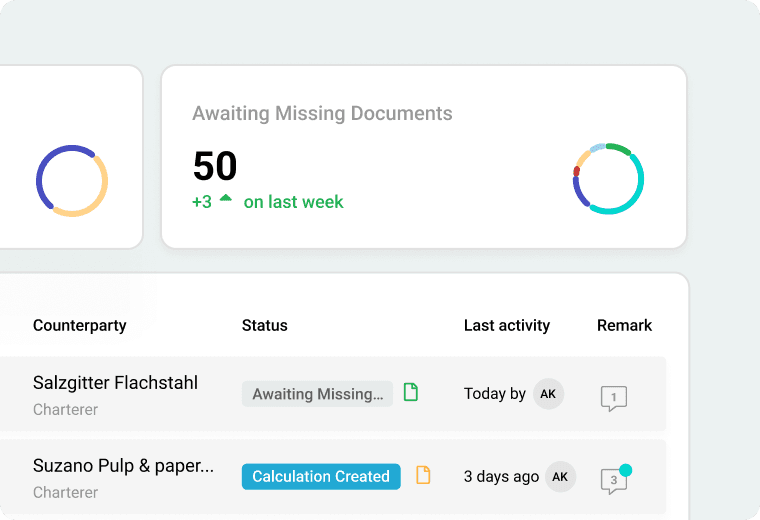
Estimate your lost time and claims risk in 90 seconds
Integrated with your workflow
Your partner to seamless ERP and AP integrations
With over 20 years of experience, we've partnered with 30+ ERPs and third-party AP systems for seamless integrations. Avoid complexity with custom set-ups and additional cost, ensuring you're set up for success with the preferred tools.


Comprehensive tools and market-leading data for your port call management
Get your voyage estimation right
Estimate and plan your port calls based on data, and mitigate the risks of mispricing freight.
Appoint qualified-only agents
Choose between our 10,000+ qualified agents, avoid getting lost in unfamiliar ports.
Seamless approvals of PDAs and FDAs
Let us run the 1,800 validation checks and provide expert guidance throughout the process
Enjoy discounted contracts with port service providers
Skip the hassle of negotiating separate contracts and benefit from our negotiated discounts.
Improve voyage predictions
Benefit from our pool of knowledge and data—beyond just your own—to predict your next voyage.
Integrate learning loops
Enhance efficiency by integrating learnings into your organisation's internal processes.
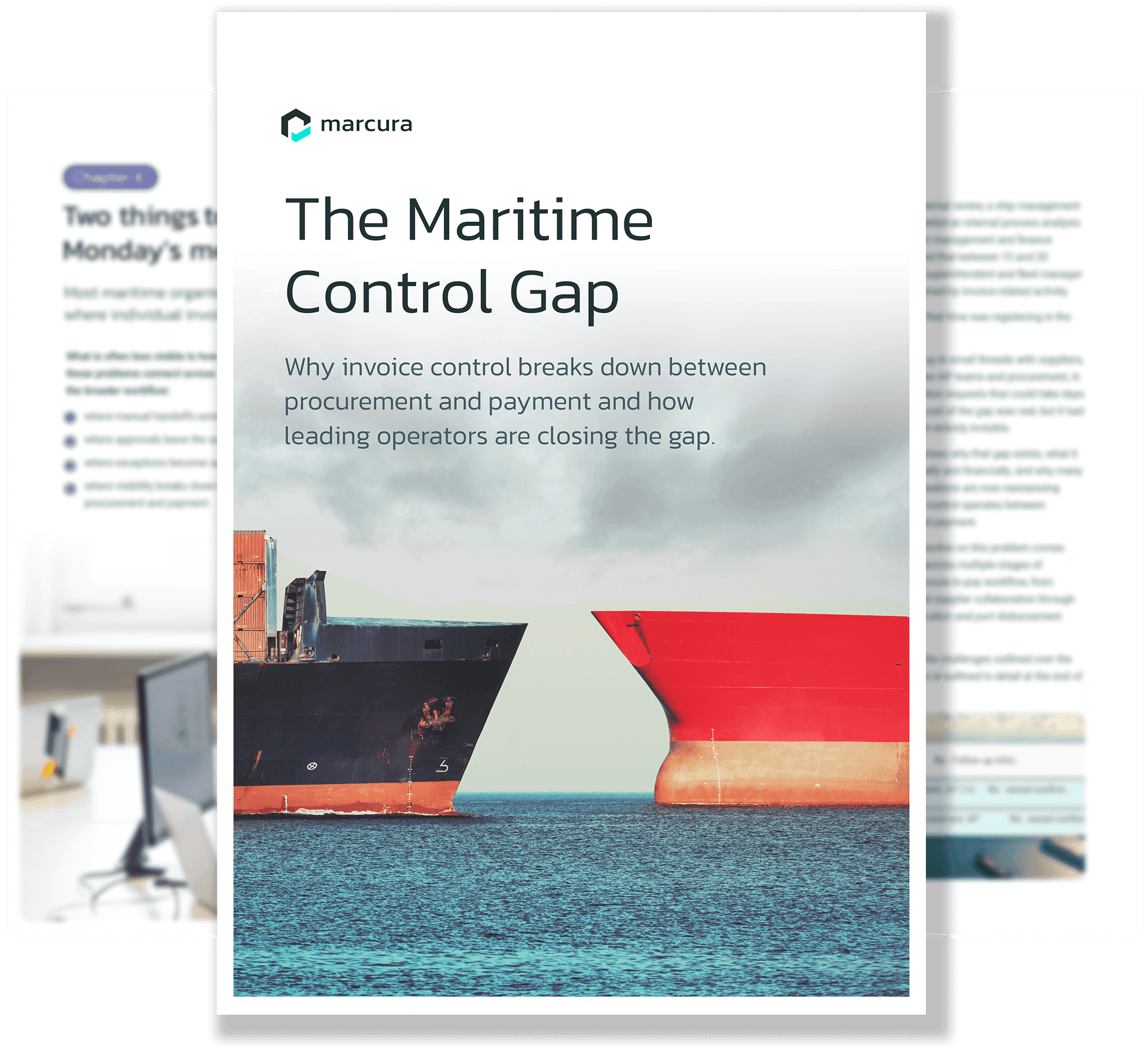
New guide
Take control of Procure-to-Pay
Why invoice control breaks down between PO and payment — and how leading ship managers close the gap. Free guide, plus two diagnostic tools.